Grown-Up Goals. Kid-Sized Joy.
Learning in disguise.
Preschool Cowboy Center
Objective: Children will explore the world of cowboys through imaginative play, creative activities, and hands-on learning experiences.
Center Setup:
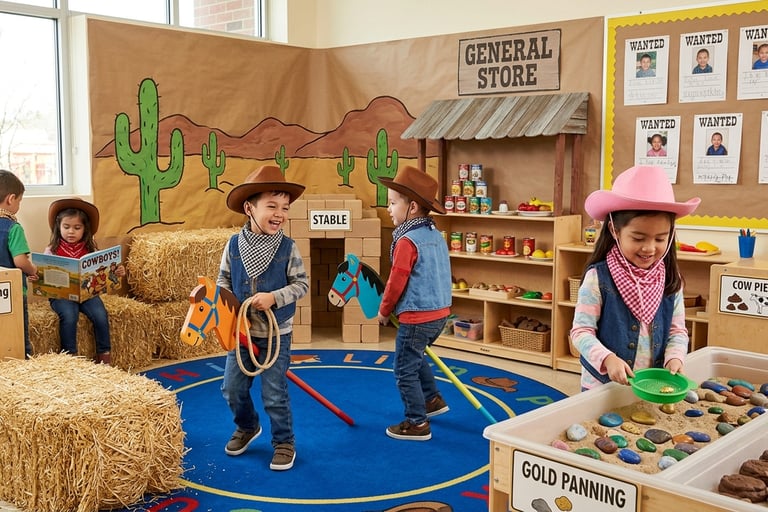
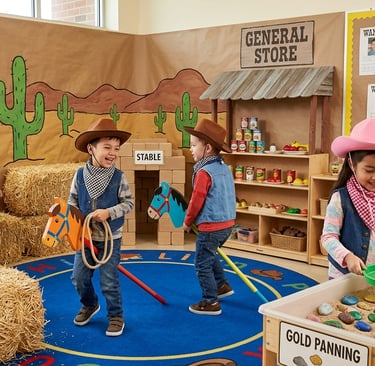
Designated Area: Create a "Wild West" area with a backdrop (e.g., brown paper with cactus drawings), hay bales (if available), and a "saloon" or "general store" corner.
Materials:
Cowboy hats, vests, bandanas
Toy horses or stick horses
Ropes (soft, safe material) (these require extra supervision to avoid the danger of strangulation)
Toy lassoes (hoop and rope) (these require extra supervision to avoid the danger of strangulation)
"Gold nuggets" (painted rocks or plastic coins)
"Wanted" posters (blank or with simple drawings)
Art supplies (paper, crayons, paint)
Blocks (for building a "saloon" or "stable")
Play dough (for making "cow pies" or "horseshoes")
Books about cowboys and the Wild West
Music (country or western)
Activities:
1. Dramatic Play (Saloon/General Store/Stable):
Role-Playing: Children can pretend to be cowboys, cowgirls, saloon keepers, or store owners.
Building: Use blocks to construct a saloon, stable, or fort.
"Shopping": Set up a general store with play food and other items for children to "buy" and "sell."
2. Cowboy Skills (Roping/Riding):
Roping: Children can practice "roping" toy horses or stuffed animals with a toy lasso.
Riding: Use stick horses or toy horses for imaginative "riding" adventures.
Rodeo Games: Set up simple rodeo games like "barrel racing" (around cones) or "bull riding" (on a rocking horse).
3. Creative Arts and Crafts:
"Wanted" Posters: Children can create "wanted" posters with drawings of themselves or their friends.
Cowboy Hats and Vests: Decorate plain hats and vests with paint, markers, and stickers.
Horseshoes: Use play dough to create "horseshoes" and decorate them with glitter or paint.
Cactus Art: Paint or draw cactus plants on paper.
4. Story Time and Music:
Cowboy Stories: Read books about cowboys and the Wild West.
Cowboy Songs: Sing cowboy songs and play country or western music.
Storytelling: Encourage children to create their own cowboy stories and act them out.
5. Sensory Exploration:
"Gold Panning": Fill a bin with sand or dried beans and hide "gold nuggets" for children to find.
"Cow Pies": For a little gross factor: make "cow pies" with play dough and add texture with cocoa powder.
"Horse Grooming": Provide brushes and cloths for children to "groom" toy horses.
6. Math and Literacy:
Counting "Gold": Children can count and sort "gold nuggets."
"Wanted" Poster Writing: Practice writing letters and simple words on "wanted" posters.
Matching Game: create a matching game with cowboy related items.
Differentiation:
Younger Children: Focus on simple activities like dramatic play and sensory exploration.
Older Children: Encourage more complex role-playing, storytelling, and creative projects.
Children with Special Needs: Adapt activities to their individual needs and provide extra support as needed.
Assessment:
Observe children's engagement in imaginative play and creative activities.
Assess their ability to follow directions and participate in group activities.
Evaluate their development of fine and gross motor skills.
Note their language development and storytelling abilities.
Extensions:
Plan a "cowboy day" with cowboy-themed snacks and activities.
Invite a guest speaker (e.g., a rodeo performer or a historian) to visit the classroom.
Take a field trip to a local farm or ranch.
Create a cowboy-themed bulletin board with children's artwork and stories.
Do you want to go the extra mile (or miles)?
Expanded Environment:
Create distinct areas: a "Chuckwagon Kitchen," a "Cowboy Camp," a "Trading Post," and a "Storytelling Circle."
Use authentic-looking materials: burlap sacks, weathered wood, tin cans, and natural fabrics.
Incorporate visual aids: maps of the American West, pictures of historical cowboys, and illustrations of cowboy tools and equipment.
Enhanced Materials:
Replica cowboy tools: lariats (soft rope), canteens, tin cups, and cooking utensils.
Trading post items: beads, feathers, faux furs, and simple tools for "trading."
Authentic-looking clothing: denim vests, leather chaps (simplified), and bandanas in various patterns.
Books: Include both fictional and non-fictional books about cowboy life, Native American cultures, and the history of the West.
Activities:
1. Historical Exploration (Chuckwagon/Camp):
Chuckwagon Cooking:
Set up a pretend chuckwagon with tin plates, cups, and cooking utensils.
Discuss the types of food cowboys ate (beans, biscuits, jerky).
Engage in pretend cooking and serving "meals."
Cowboy Camp:
Create a campfire area (using battery-operated lights or fabric).
Discuss the daily life of a cowboy, including sleeping under the stars and tending to horses.
Practice setting up a simple "camp" with blankets and pillows.
2. Cultural Awareness (Trading Post/Storytelling):
Trading Post:
Introduce the concept of bartering and trading.
Discuss the interactions between cowboys and Native American tribes.
Engage in pretend trading activities, using beads, feathers, and other items.
Storytelling Circle:
Create a designated area for storytelling, using blankets and pillows.
Share stories about cowboy legends, Native American folklore, and historical events.
Encourage children to create and share their own stories.
Introduce sign language that cowboys would have used.
3. Enhanced Cowboy Skills:
Lasso Practice:
Use soft ropes and targets to practice lassoing skills.
Discuss the importance of roping in cattle herding.
Navigation:
Use maps and compasses (toy) to navigate pretend trails.
Discuss the challenges of traveling across the vast landscapes of the West.
Animal Care:
Learn about the care of horses, including grooming, feeding, and saddling.
Engage in pretend horse grooming and care activities.
4. Creative Expression and Critical Thinking:
Historical Art:
Create artwork depicting scenes from cowboy life, such as cattle drives and campfires.
Use natural materials, such as clay and pigments, to create artwork.
Problem-Solving Scenarios:
Present children with scenarios that cowboys might have faced, such as a lost herd or a broken wagon wheel.
Encourage children to work together to find solutions.
"Cowboy Code" Discussion: Discuss the ethics and morals of cowboy life.
5. Integrated Learning:
Math: Measure distances on maps, count cattle, and calculate trading values.
Science: Learn about the plants and animals of the American West.
Social Studies: Explore the history of the American West and the interactions between different cultures.
Literacy: Write stories about cowboy adventures, create "wanted" posters with detailed descriptions, and read historical accounts.
Differentiation:
Younger Children: Focus on sensory exploration, dramatic play, and simple storytelling.
Older Children: Encourage more complex role-playing, historical research, and problem-solving.
Children with Special Needs: Adapt activities to their individual needs, provide visual aids, and offer extra support.
Assessment:
Observe children's engagement in historical exploration, cultural awareness, and creative activities.
Assess their ability to understand and discuss the challenges and experiences of cowboy life.
Evaluate their development of critical thinking, problem-solving, and social skills.
Document their creative expressions and storytelling abilities.
Extensions:
Organize a "cowboy day" with historical reenactments, traditional food, and cowboy music.
Invite a guest speaker, such as a historian or a Native American storyteller, to share their knowledge.
Take a virtual field trip to a historical site or museum related to the American West.
Create a classroom "Cowboy Museum" with children's artwork, artifacts, and stories.