Grown-Up Goals. Kid-Sized Joy.
Learning in disguise.
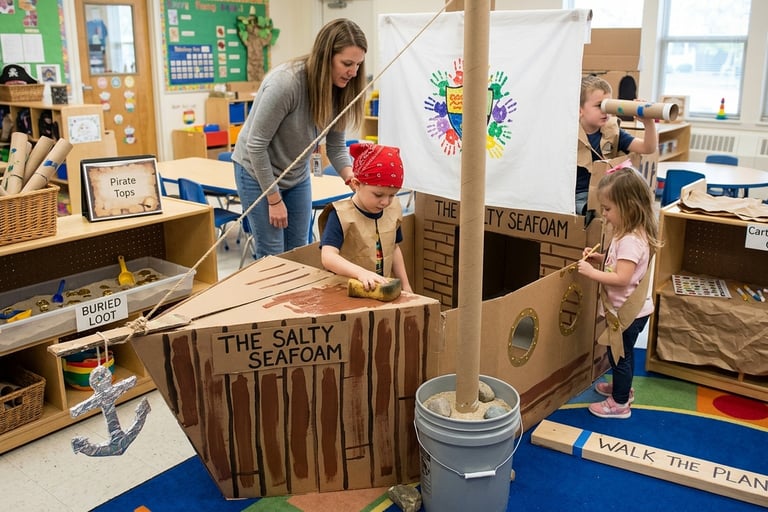
🏴☠️ Welcome to Adventure Cove Pirate Center
Setting up a pirate ship center is all about high-seas drama and hidden treasures. It’s a perfect theme for practicing sharing, imaginative storytelling, and basic "navigation" (directional) skills.
Building a pirate ship is one of the most rewarding collaborative projects you can do in a preschool classroom. It combines engineering, teamwork, and high-level imaginative play.
Here is a guide to building a "Joyful Pirate Ship" using affordable materials and maximum child involvement.
Phase 1: Gathering the "Lumber"
You won't be using real lumber. Instead of buying a pre-made ship, use large appliance boxes. We are keeping the cost down and using easy to find materials. Contact appliance companies that do deliveries. (Think about a box for a washer, dryer, refrigerator, water heater, etc.) This allows the children to see how a flat object becomes a 3D structure.
The Hull: Find 2–3 large refrigerator or washing machine boxes.
The Mast: Use a tall carpet tube or several sturdy wrapping paper tubes taped together.
The Rigging: Use thick yarn or clothesline.
Phase 2: Construction (The Kids' Job)
While you handle the heavy-duty box cutting, the children should be the primary "shipbuilders." You can set the stage ahead of time by reading pirate stories. The night before the big reveal, you get the cardboard boxes ready. Can you imagine how excited the kids will be when they enter the classroom and see the start of their ship? The kids will be ready to add to the creation that morning.
Pro-Tip for the "Big Reveal": If you can, have the "Hull" and "Mast" standing when the children arrive, but leave the painting and outfitting completely to them. It gives them the structure to be excited, but the "work" to feel like real shipbuilders!
1. Painting the Planks
Don’t just paint the box brown. Give the kids sponges and let them "stamp" wooden planks onto the cardboard. This helps with fine motor control and pattern recognition.
2. Designing the Portholes
Draw circles on the sides of the ship and let the children help you "punch" them out. They can then decorate the edges of the portholes with "rivets" (using gold stickers or silver markers).
3. Crafting the Figurehead
Every ship needs a mascot! Have the children vote on an animal figurehead for the bow. They can decorate a separate piece of cardboard to look like a Squeaky the Squirrel pirate or a Ryder the Raccoon captain and tape it to the front.
Phase 3: Setting the Sails
A ship isn't a ship without sails! This is a great opportunity for a group art project.
The Main Sail: Use an old white bedsheet or large pieces of butcher paper.
The Artwork: Lay the sail flat on the floor. Let the children use handprints or fabric markers to create the ship's crest.
Assembly: Cut small holes in the sail and thread it onto your "mast" tube. Secure the tube inside a heavy bucket filled with rocks or sand to keep it upright inside the box.
Phase 4: Outfitting the Crew
A ship needs tools to navigate the high seas. Set up a "Ship's Workshop" nearby:
Telescopes: Use paper towel rolls. Children can paint them and add a "lens" made of clear plastic wrap and a rubber band.
The Steering Wheel: Use a large pizza circle or a plastic hula hoop. Attach it to a smaller box at the "back" of the ship so the Captain can steer.
The Anchor: Cut a large anchor shape out of cardboard and let the kids wrap it in aluminum foil. Attach it to the ship with a long piece of rope.
Pirate Ship "Learning in Disguise"
Gross Motor: Climbing in and out of the "hull" and balancing while "steering."
Social-Emotional: Negotiating roles (Who is the captain? Who is the lookout?).
Early Literacy: Have the kids help you write signs like "Captain's Quarters," "Galley," or "Beware of Sharks!"
Math: Counting the "cannons" (black bean bags) or measuring the length of the ship using their own footprints.
⚓ The Ship: "The Salty Seafoam"
The Hull: Use two large appliance boxes opened up to form a "V" shape for the bow. Paint it wood-brown or cover it with brown butcher paper.
The Mast: A tall PVC pipe or a sturdy cardboard carpet tube secured in a weighted bucket. Attach a white pillowcase or a black sheet with a "Jolly Roger" skull (or a friendly smiley face!).
The Helm: A large pizza box lid cut into a circle with cardboard "spokes" glued on. Attach it to the "bridge" with a brass fastener so it actually spins.
🏝️ Activity Stations
Station Name Materials Needed The "Mission"
Treasure Dig Sandbox or bin, gold coins, "gems" (beads), scoops Sensory: Sift through the sand to find the buried loot. Great for fine motor control!
Cartography Club Crinkled brown paper, markers, stickers Literacy/Art: Draw a map of the classroom. X marks the spot at the cubbies!
The Crow's Nest: Cardboard tubes (toilet paper/paper towel), tape STEM: Decorate "spyglasses." Use them to spot "land ho!" across the room.
Walk the Plank A 2x4 piece of wood or a strip of blue tape on the floor Balance: Balance across the plank without falling into the "shark-infested" blue rug.
🍖 The Galley (Snack Time)
Fish Food: Goldfish crackers served in small paper cups.
Cannonballs: Grapes or melon balls.
Shipwrecks: Apple slices with a cheese slice "sail" held on by a toothpick (with supervision, of course!).
🦜 Pirate Lingo to Teach
Ahoy!: Hello!
Avast!: Stop and pay attention!
Hearties: Friends or teammates.
Land Ho!: I see the playground!
Quick Tip: To keep the "battles" friendly, establish a "Pirate Code" (Classroom Rules).
1. Pirates always share the treasure.
2. Pirates use their words, not their hooks.
3. Pirates help their crew clean up the deck.
Choose what you want to focus on the building/construction side of the ship? Or the dramatic play and costumes?
For a preschool setting, pirate costumes should be easy to move in and simple to take on or off. You can create a high-seas look using mostly items from a scrap bin or a "lost and found" pile.
⚓ The "Instant Pirate" Essentials
The Headband: A strip of red or black fabric tied around the forehead. This is much easier for kids to keep on than a bulky hat.
The Tattered Shirt: Take an old white or striped T-shirt and cut "v" shapes into the hem and sleeves to give it a rugged, "survived a shipwreck" look.
The Sash: Tie a long scarf or a piece of fabric around the waist over their shirt. It’s an instant pirate silhouette.
🛠️ Easy DIY Props
Cardboard Hooks: Cut a hook shape out of cardboard and cover it in aluminum foil. Poke it through the bottom of a plastic or paper cup so the child can "hold" the hook from the inside.
No-String Eyepatches: Instead of itchy elastic, cut an oval out of black felt or cardstock and use a small piece of medical tape or a temporary adhesive to stick it near the eyebrow. (Or just use black face paint to draw one on!)
Paper Towel Spyglasses: Tape two cardboard tubes together and let the kids decorate them with gold markers or stickers.
Vest from a Bag: Take a brown paper grocery bag, cut a slit up the middle and holes for the arms. Crumple it up and flatten it back out a few times to make it look like "worn leather."
🦜 Character Touches
The Shoulder Sidekick: Tape a small stuffed bird (like a parrot) or even a cut-out paper bird to the shoulder of a shirt.
Beards & Scars: Use a washable brown or black makeup crayon to draw a "soul patch" on the chin or a little "X" on a cheek.
Golden Hoop: If you have gold pipe cleaners, loop one loosely around an ear (like a clip-on) for a safe pirate earring.
💡 Classroom Costume Chest Tip
If you are setting this up as a Learning Center, keep a basket of "Pirate Basics":
Striped socks (to wear over leggings/pants).
Clip-on gold jewelry (oversized and plastic).
Vests (old waistcoats or DIY paper ones).
A creative touch to get the children giggling is to do the "Pirate Name Generator" activity.
This is a great way to help the kids "get into character" as soon as they put on their gear! You can print these lists out on parchment-style paper (soak white paper in tea and let it dry for that old-world look) and post it right by the costume bin.
To create a name, have each child pick one word from Column A and one from Column B.
🏴☠️ The "Official" Pirate Name Maker
Column A (The Descriptor)Column B (The Sea Name)SaltyBeardBarnacleStormGoldieMcSnickersCaptainPlankwalkerWobbleWave-RiderPatchyParrot-PalSunnySkylarkBraveAnchor
🎲 How to Use It in the Center
The Name Tag Station: Once they have their pirate name, help them write it on a "Ship’s Log" or a sticky-back name tag shaped like a gold coin.
The Roll Call: During circle time, address them only by their pirate names. "Captain Wave-Rider, would you like to lead the crew to the snack table?"
The "Pirate Passport": If they are doing different activities (the dig, the map making), they can get a stamp on a small card next to their pirate name for every mission completed.
⚓ A Quick "Pirate Oath"
Before they enter the center, have them raise a hand (or a hook!) and repeat:
"I promise to be a helpful matey, To share the gold and not be hasty. To help my crew and keep the peace, Until our high-seas adventures cease!"
"Pirate Map" scavenger hunt
A scavenger hunt is the perfect way to get the "crew" moving and using their new gear. You can make this as simple or as involved as you like!
Lop
Instead of a complex map, give the kids visual clues (drawings) of where things are hidden. You can hand these out as "Secret Orders."
The Landmarks
Hide 5-6 "Gold Coins" (yellow paper circles or plastic coins) in these common preschool spots:
The "Blue Lagoon": Under the blue rug or by the water table.
The "Mountain of Knowledge": Tucked inside a book in the reading nook.
The "Evergreen Forest": Near a potted plant or the play kitchen "vegetables."
The "Cave of Echoes": Inside a large tunnel or under a draped table.
The "Giant's Footprint": Hidden inside a stray boot or shoe in the cubby area.
The Final Prize
Once they collect all the coins, they bring them back to the Pirate Ship Center to "unlock" the treasure chest.
The Chest: A shoebox painted gold or covered in foil.
The Treasure: This could be "Gold Nuggets" (corn puffs/cereal), "Jeweled Stickers," or even just a new book about pirates to read together.
⚓ Variations for Different Ages
For 3-year-olds: Use a "Color Hunt." Tell them, "Find one red jewel, one blue jewel, and one green jewel hidden in the room."
For 4/5-year-olds: Use "Directional Clues." Say, "Take five giant pirate steps toward the window, then look under the 'rock' (a pillow)."
🦜 The "Captain’s Log" (Literacy Tie-in)
As they find each item, have them "check it off" their map with a stamp or a big "X." It’s great practice for following a sequence and completing a task!
Quick Tip: To avoid a "stampede," you can have the kids hunt in small teams (2 or 3 "mateys" at a time) while the rest of the crew works on their costumes or ship decorations.
Pirate-themed music to play in the background:
Music sets the mood for any "high-seas" adventure! For a preschool environment, you want a mix of rhythmic songs they can stomp to and some atmospheric background tunes that aren't too scary.
🎶 The "Pirate Play" Playlist
Song TypeRecommendationWhy it Works
Active/Movement: "The Goldfish (Let's Go Swimming)" by The Laurie Berkner Band It’s a classic "ocean" song that gets kids jumping and "sleeping" on command.
Traditional Rhythms: Instrumental Sea Shanties (Search for "Accordion Sea Music") The fast accordion and violin music is perfect for "scrubbing the deck" or dancing.
Silly/Fun: "A Pirate You Shall Be" by Jack Hartmann Great for following directions and learning pirate "actions" (like looking through a spyglass).
Atmospheric: Pirates of the Caribbean Theme (Short clips)Use this for the "Big Reveal" of the ship or the start of the Treasure Hunt to build excitement.
🥁 DIY Pirate Instruments
If you want the kids to make their own "Pirate Band" while they explore the ship:
Ocean Drums: Fill paper plates with dried beans or rice, staple the edges shut, and decorate the outside with fish stickers. When they tilt them, it sounds like waves crashing.
Rhythm Hooks: Use the cardboard hooks they made earlier to "tap" along to the beat on the side of the cardboard ship.
The "Jolly Roger" Shakers: Small plastic eggs or containers filled with "silver" (metal washers or pennies) to sound like a treasure chest rattling.
🌊 Sound Effects for the Center
To make the center feel truly immersive, you can play a loop of Ocean Ambience in the background:
Gentle waves lapping against wood.
A distant seagull crying.
The creak of a wooden ship.
💡 The "Freeze Dance" Pirate Edition
Play some upbeat sea shanty music and have the kids dance like pirates (stumping their "peg legs" or swinging their "swords"). When the music stops, they have to "Freeze like a Statue" so the Sea Monster doesn't see them!
Would you like some picture book suggestions to read during the quieter "rest" time in the Starlight Lounge or the Ship's Cabin?
Reading a story is a perfect way to transition from high-energy "battles" to a calmer focus time. Since preschoolers have a wide range of attention spans, it’s great to have a mix of silly stories and ones with great illustrations.
📚 Pirate Picture Books for the "Ship’s Library"
"How I Became a Pirate" by Melinda Long (audio book) or Hardcover book: A classic story about a boy who joins a pirate crew and learns that while adventure is fun, pirates don't get tucked in at night. It’s excellent for discussing routines.
"The Night Pirates" by Peter Harris: This one features a crew of girl pirates! It has a wonderful rhythmic quality that makes it a great "read-aloud" for the whole group.
"Pirates Love Underpants" by Claire Freedman: If you want the kids to dissolve into giggles, this is the one. It’s silly, colorful, and very popular with the 3–5 age group.
"Pete the Cat and the Treasure Map" by James Dean: Since many preschoolers already know and love Pete the Cat, this is a familiar way to introduce the concept of a "secret map" and teamwork.
"There Was an Old Pirate Who Swallowed a Fish" by Jennifer Ward: A fun nautical twist on the "Old Lady Who Swallowed a Fly" rhyme. It’s great for memory and repetition.
⚓ Tips for "Pirate Storytime"
The Captain’s Voice: Use a slightly gravelly (but friendly!) pirate voice for the dialogue. Use words like "matey" and "shiver me timbers" to keep them engaged.
Interactive Reading: Ask the kids to look for the "hidden" parrot or the "X" on the page before you turn it.
Prop Reading: Hold your cardboard spyglass while you read. Every time a character sees something, have the kids look through their own "spyglasses" too.
🌊 A Calm-Down Activity: "Floating on the Waves"
After the story, have the kids lie down on the "deck" (the rug) and close their eyes. Ask them to pretend they are floating on a gentle boat. Have them breathe in deeply like the ocean wind and breathe out like the crashing waves. It’s a perfect way to reset before the next part of your day.
The Master List of things to gather:
Cardboard Boxes: (Consider your room or outdoor size for how big you can make your ship!) 1–3 large refrigerator or washing machine boxes
The Mast: A tall carpet tube, several sturdy wrapping paper tubes, or a PVC pipe.
Adhesives: Heavy-duty duct tape (brown or silver), packing tape, and wood glue or a hot glue gun (for teacher use).
Cutting Tools: Box cutter or utility knife (strictly for teacher use).
Paint Supplies: Brown washable tempera paint, large sponges (for "plank" stamping), and paint trays.
Decorating Tools: Gold stickers, silver/gold permanent markers (for "rivets"), and thick black markers.
The Figurehead: Extra scraps of cardboard, markers, and tape to create Squeaky the Squirrel or Ryder the Raccoon.
The Main Sail: An old white bedsheet, a white pillowcase, or large rolls of white butcher paper.
Rigging: Thick yarn, clothesline, or twine.
Mast Support: A large, heavy bucket or a 5-gallon pail.
Weight: Rocks, sand, or heavy hand weights to stabilize the mast inside the bucket.
Sail Decor: Fabric markers or washable paint (for handprint "crests").
Telescopes: Paper towel and toilet paper rolls, clear plastic wrap, and rubber bands.
The Helm (Steering Wheel): A large pizza box lid or a hula hoop, cardboard "spoke" cutouts, and a large brass fastener (so it spins).
The Anchor: Cardboard, aluminum foil, and a length of rope.
Hooks: Plastic/paper cups and cardboard hooks covered in foil.
Eyepatches: Black felt or cardstock and medical tape (skin-safe adhesive).
Vests: Brown paper grocery bags.
Treasure Dig: A sensory bin or sandbox, plastic gold coins, "gems" (large beads), and scoops/sifters.
Cartography Club: White paper (pre-soaked in tea for an "aged" look), brown crayons, and stickers.
Walk the Plank: A 2x4 piece of wood or a roll of blue painter’s tape for the "water," or a blue piece of fabric.
Scavenger Hunt: Yellow paper circles (for hidden coins) and a "Treasure Chest" (shoebox covered in foil).
The Final Prize: Stickers, "gold" cereal, or a new pirate book.
Food: Goldfish crackers, grapes or melon balls, apple slices, and cheese slices.
Serving: Paper cups and toothpicks (for the cheese "sails").
Audio: A Bluetooth speaker and a playlist featuring The Laurie Berkner Band, Jack Hartmann, and instrumental sea shanties.
DIY Instruments: Paper plates, dried beans/rice, and plastic eggs.
Visuals: A small disco ball or "puck" lights for a magical effect.