Grown-Up Goals. Kid-Sized Joy.
Learning in disguise.
Post Office
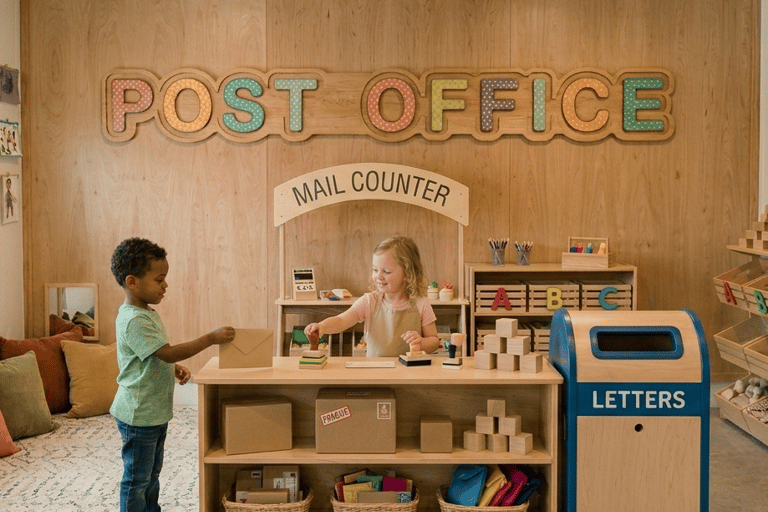
1. Set Up the "Post Office"
Designate a space: Choose a corner of the classroom or a small table to be your "post office."
Decorate: Use colorful paper, pictures of mailboxes, and toy mail trucks to create a festive atmosphere.
Gather materials: * Empty boxes or bins for mail sorting
Play mail envelopes and packages (brown paper bags, cardboard boxes)
Stamps (stickers work great for pretend stamps)
Address labels (blank or with simple addresses)
Pencils, crayons, or markers for writing addresses
Toy telephones or walkie-talkies for communication
2. Role-Playing Activities
Mail Carrier: Children can pretend to be mail carriers, delivering mail to different "houses" (desks, cubbies) in the classroom.
Costumes: Simple costumes are available to add to the experience.
Post Office Workers: Children can work as post office employees, sorting mail, stamping envelopes, and preparing packages for delivery.
Customers: Children can write letters, address envelopes, and "mail" them at the post office.
Customer Service: Children can practice customer service skills by helping other children "mail" their letters.
3. Learning Activities
Alphabet and Number Recognition: Use envelopes and packages with letters, names, and numbers on them to practice identification. Preschool children will begin to recognize the names of other children in the class, if the names are on tables, cubbies, and other spots that need identified.
Fine Motor Skills: Children can practice writing addresses, stamping envelopes, and sorting mail.
Social Skills: Children can learn about sharing, taking turns, and communicating with others.
Counting and Math: Children can count the number of letters, stamps, and packages.
Literacy: Encourage children to write simple messages or draw pictures in their letters.
Geography: Introduce basic map skills by having children "deliver" mail to different parts of the classroom.
4. Creative Extensions
Make "mail" from recycled materials: Use paper scraps, cardboard tubes, and other materials to create unique mail envelopes and packages.
Create a "lost and found" box at the post office for children to "find" and return lost items.
Have children create their own stamps using paint or other art materials.
Read stories about mail carriers and the postal system.
Invite a guest speaker from the local post office to visit the classroom.
Remember to:
Keep it fun and engaging: Focus on play and exploration.
Encourage creativity and imagination: Let children use their own ideas and approaches.
Provide clear instructions and guidance: Help children understand the roles and responsibilities of a post office.
Clean up together: Involve children in cleaning up the post office after playtime.
The children will be excited when you surprise them with a fun and educational "Post Office" center. They will develop new skills including valuable social and academic skills.
Do you want to enhance this experience?
Enhanced Preschool Post Office Center
Elevating the Play Space:
Transform the "Post Office":
Create a "Post Office Window": Use a sheet or fabric to create a window where customers "hand" in their mail.
Add a "Sorting Room": Designate an area behind the window for sorting mail, with shelves and bins for organizing letters and packages.
Include a "Mail Carrier's Corner": Provide a backpack or mail bag for children to carry mail around the classroom.
Enhance the Props:
Create realistic props: Include real (empty) envelopes, stamps, and address labels.
Make "special delivery" items: Include small, lightweight packages like stuffed animals or toy cars.
Add a "Lost and Found" box: Children can "find" and return lost items.
Expanding Learning Opportunities:
Literacy Focus:
Introduce simple letter writing templates.
Encourage children to write "thank you" notes or "friend letters."
Introduce the concept of return addresses.
Read stories about the postal service and mail carriers.
Math Integration:
Count stamps, weigh packages (using a toy scale), and calculate pretend postage costs.
Sort mail by size, shape, or destination.
Social-Emotional Learning:
Emphasize the importance of communication and customer service.
Encourage children to share, take turns, and resolve conflicts.
Discuss the importance of responsibility and delivering mail safely.
Community Connections:
Invite a local mail carrier to visit the classroom.
Plan a field trip to the local post office (if possible).
Collect and recycle old envelopes and packaging materials.
Creative Enhancements:
"Mail Art" Station: Encourage children to create their own stamps, envelopes, and postcards using art materials.
"Special Delivery" Challenges: Create challenges like delivering mail to specific locations in the classroom or delivering mail to "friends" in other classrooms.
"Lost and Found" Dramatic Play: Children can act out scenarios where they have lost something and need to find it.
"Mail Delivery Service" for the Classroom: Children can deliver classroom supplies, messages, or artwork to teachers and other classrooms.
Technology Integration:
Use a tablet or computer to research the postal service.
Create digital postcards or letters using drawing apps.
Watch videos about how mail is processed and delivered.
Assessment:
Observe children's interactions and language during play.
Assess their understanding of mail delivery concepts.
Evaluate their ability to follow directions and complete tasks.
Playing in this center will help the children understand more about the world around them.